


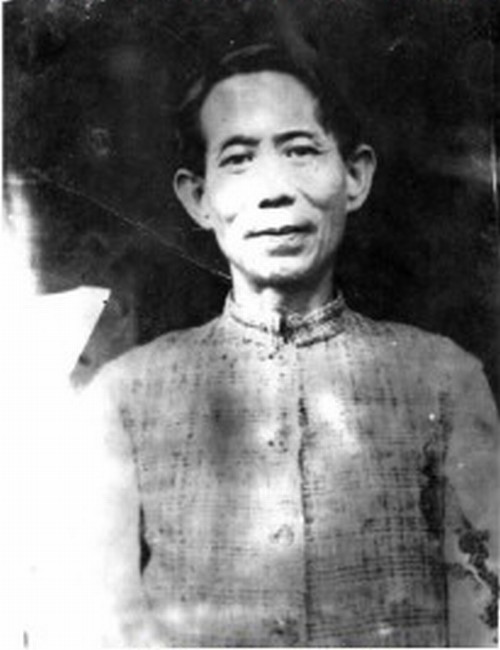
Hijam Irawat, poor orphan to people’s hero, builder of Manipuri Freedom Movement as well as social activist was born in a hut during the feudal society in Manipur under the British rule. Irawat was the unquestioned leader of Manipuri people during those days and was regarded as a legendary hero in every Manipuri Home. His life became a metaphor of hut to temple and temple to hut as humanist, leader of the people against feudalism as an antifascist, introducing social political – literary movements with communist revolutionary ideals and religiously also for the unity and integrity of the people. Jana Neta or Meeyamgi Luchingba, Hijam Irawat was the son of Hijam Ibungohal and Chongtham Ningol Hijam Ongbi Thambalnganbi, born on 30 September 1896 at Pishum Oinam Leikai, after his father’s death, he moved with his mother to stay with his aunt Sougaijam Ongbi Ibeton Devi at Moirangkhom Sawaijam, Imphal.
He studied at Johnstone School, Imphal, till class VII. In 1913 he went to Dhaka with his cousin Sawaijam Somorandro and got admitted at Pugoji High School to study till class IX. In 1915 he dropped out due to shortage of money and some other reasons. He went to some places of Tripura where Manipuri were resided, which was the idea of thinking for the people service. Later that year he came back to Manipur and he found that his mother was no more so that he was roaming aimlessly here and there. After his mother’s death and his return from Dacca in 1915 he was sheltered in the house of Maibam Samden of Wangkhei, Imphal. It was the turning point of his life to go to the palace because of his friend’s father Maibam Shamdren who worked in the court of King Churachand Maharajah. It was then that he became in good relations with the royal family so as he got married with the King’s elder brother’s daughter Princes Khomdonsana due to his outstanding performance of art and culture, games and sports etc. He was then appointed a member of the Sadar Panchayat which was the high post in those days. As a member of the Sadar Panchayat, he visited and mixed with the people to know their problems. It was the best opportunities for giving message his thought and sharing his views and ideas to the people
Hijam Irawat was a nationalist before he was a Marxist so that he took many works for the society in all the aspects such as, socio-political-economic cultural activities etc. He was also the icon of the socialist revolutionary of northeast Actually his contribution was a very great and significant because he took part as the very important role for the formation of Manipuri Mahasabha in 1934, second Nupi Lal, stood against the social ills such as, chanden shelkhai, peon chakthak, yarek santri, jal janabhumi sambhandhi (Water connection), Loushal, Amin Chakthak, Dolaireng, Yarek Sentry, Wakheisel, Mangba – Sengba etc. Brahama Sabha, campaign for popular franchise and also further he expressed against the autocratic colonial master in the Rastriya conference. He summoned as strike and demanded to ban the caning of pupils in the class which was his first revolt as a humanist. His youthful enthusiasm was naturally diverted to literary movement for expressing patriotism with the spirit of cultural and emotional integration, feeling of oneness, unity of the people against feudalism. In those days only 5 to 6 % of the total population was literate and the rest are peasant class whose livelihood activities were based on agriculture.
The ancient administrative machineries of the ruling monarchs of Manipur were changed into oppressive forces by Maharajah Churachand Singh who ruled during the period of 1891-1941 and then to Maharajah Bodha Chandra Singh’s period of 1941-1949.The resentment against the king became gradually volatile. Hijam Irawat, a leader with Communist inclination came to the fore at the spur of the moment. Irawat was arrested from his house on 9th January 1940 and sentenced to 3 years of simple imprisonment under section 124 A of IPC on the ground of inflammatory speech. Irawat was in Imphal Jail for the first one year of simple Imprisonment and later shifted to Sylhet Distict Jail. From the Sylhet went to Cachar almost six years of political exile where he plunged headlong into the peasant movement and also performed many theatre works and activities of Swadeshi Ganer Dal to develop cultural unity among peasants including Manipur peasants and non-Manipuri peasants and tea labourers to liberate themselves from the yokes of the foreign rules as well as from the shackles of the feudal oppressors. After six years of political exile, Irawat was finally permitted to enter Manipur. Maharajah Bodha Chandra Singh denied the entry of Hijam Irawat to Manipur after the Sylhet District Jail on the charge of being communist.
The destiny of Hijam Irawat took a paradigm shift from elected person to an armed revolutionary movement after the incident of Pungdongbam, Lamlai Imphal East, Manipur in the period of 1948-1951.A scuffle took place when the Krishaks of the Lamlai Branch came to attend the meeting with the Manipur State Police under the command of Sub-Inspector Naran Singh at Pungdongbam, Lamlai. But unfortunately S.I. Naran Singh was mortally wounded and died instantaneously at the spot. On the same day the Manipur Krishak Sabha and Manipur Praja Sangha were declared unlawful organisation. On that day his destiny went to the underground even though he was elected to the State Assembly from the Utlou Constituency.
On 26th September 1951, Comrade Irawat left this world before he could reach his motherland and communicate his achievement to his comrades on account of typhoid fever at the Tangbaw Village, Burma. So as his life span was very short lived, only 56 years old; born and died in September so that some interested political parties as well as civil social organisations (CSOs) celebrated as the ‘September Thabum Palon’ in and outside Manipur every year
The role in the country’s liberation movement, his struggle against the foreign rule as well as the autocratic Maharajah, his pioneering work in many fields, his tireless efforts to better the downtrodden and his able leadership in the December 12, 1939 NupiLal that caused him imprisonment and exile in Cachar from where he worked restlessly among the Manipuri and Non-Manipuri peasants and workers could not be forgotten by us. Not only this, under the unavoidable circumstances, he went to Burma and organised and convened the message of humanism, the feeling of oneness, arousing the mass movement against the imperialism with the full spirit of integration. Remembering his remarkable words, we need to respect and honour his service for the mankind forever as a humanist. Today, he not only belongs to the Communist Party of India, but also to the entire people of the land. Indeed, he is a leader of the masses who scarified everything for the cause of humanism, building National Integration project in India and across the border i.e. in Burma. To conclude he was regarded as the Jana Neta as well as modern architect of Manipur.
Writer can be reached at:[email protected]
