


By: Rajkumar Bobichand
Imphal, August 07:
While the Framework Agreement signed between the Government of India (GOI) and the Isak-Muivah faction of the National Socialist Council of Nagaland – NSCN (IM) on August 3, 2015 has completed seven years on August 3, 2022; and the Ceasefire between the GOI and the NSCN (IM) has completed 25 years on August 1, 2022, the NSCN (IM) has given politically significant statements.
The most significant statement is what the NSCN (IM) has reiterated that the Government of India proposed PAN NAGA HOHO, a cultural institution which embraces the Nagas of all Naga areas.
Moreover, the NSCN (IM) has also cautioned the Government of India that the 25 years is a long period in human life and 25 years of ceasefire is not a joke.
It may be mentioned that the ceasefire between the Government of India (GOI) and the Isak-Muivah faction of the National Socialist Council of Nagaland – NSCN (IM) became effective from August 1, 1997.
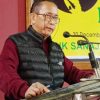
VS Atem, Member of Collective Leadership NSCN (IM) and Team Leader of Cease Fire Ground Rules Review Committee (CFGRRC) while delivering the keynote speech on the occasion of 25 years of the Ceasefire between the GOI and NSCN (IM) held at the Mission Centre, WBCC, 7th Mile, Dimapur on August 1, 2022 said, “25 years is a long period in human life and 25 years of ceasefire is not a joke. He pointed out that “many things have happened during this period, good and bad. But NSCN is still struggling to solve the problem”.
Notably, the Chairman, CFMG (Cease Fire Monitoring Group), Lt. Gen. Amarjeet Singh Bedi, (Retd.) was present as a Special Invitee at the occasion.
Others who attended the meeting were leaders from the Naga Hoho, ENPO (Eastern Nagaland People’s Organization), UNC (United Naga Council), Naga Council Dimapur (NCD), NPMHR (Naga People’s Movement for Human Rights), FNR (Forum for Naga Reconciliation), NMA (Naga Mother’s Association), NSF (Naga Students’ Federation), GNF (Global Naga Forum) and Tenyimi Union, Dimapur (TUD).
Naturally, they all expressed concern for the long years of the Indo-Naga ceasefire which is yet to find a solution to the Naga political issue. The occasion was marked by the release of a booklet, “25 Years of Indo-Naga Ceasefire (1997-2022)”, said a press note issued by NSCN (IM)’s MIP.
Meanwhile, NSCN (IM) Chairman Ino Qhehezu Tuccu while delivering his speech on the 7th commemoration of the Framework Agreement on August 3, 2022 at the Council Headquarters of the NSCN (IM), Hebron said that one of the “central points” of the Naga movement has been the “integration of all Naga territories under one political roof”.
Chairman Ino Tuccu said, “The politics of integration of all Naga territories under one political roof has been one of the central points of the movement. After series of talks between the Government of India and NSCN, it was “mutually agreed that the integration of all the Naga areas is the ‘legitimate right of the Nagas’ and that in keeping with the principle it will be finalized through political process at the earliest as mutually agreed upon”.
“As agreed upon political institutions will be instituted in the Naga areas in the so-called states of Manipur, Assam and Arunachal Pradesh in addition to the present Nagaland state, which will be transitional to the final goal. The government of India proposed PAN NAGA HOHO, a cultural institution which embraces the Nagas of all Naga areas. It will deal with the culture, custom and tradition, literature, social and interest of the Nagas, which was mutually agreed”, Chairman Ino Tuccu further stated.
While delivering his speech on the 7th commoemoration of the Framework Agreement, Chairman Inno Tuccu said that the Framework Agreement recognizes the unique history of the Naga independence and its unique situation by the Government of India. “By unique history, it means the Nagas have never been a part of the Union of India. By unique situation, it means it is political, not law and order problem of India. We say sovereignty is our inherent right and that the Nagas are a sovereign people. However, it must be recognized by other nation-states”, he asserted.
Moreover, NSCN (IM) Chairman Ino Tuccu also accused the “interlocutors of the Government of India” of making the Naga flag and constitution” an issue. “It is known to all that the flag and the constitution are component parts of the recognised sovereignty and unique history. We truly say we are Nagas, not Indians, but the Government of India did not respect the Naga national identity. The Nagas must be a recognised entity. The Naga national entity is now recognised by the Government of India”, he said.
“We believe this Framework Agreement which says, ‘It will provide for an enduring inclusive new relationship of peaceful coexistence of the two entities’ will be certainly a bridge between the two peoples, not a wall; it will also be the strong tower they have been looking for. This Framework Agreement nullifies the colonial culture of ‘forced marriage and forced Union’, and this agreement will bring the two confronting peoples closer than ever before. The two negotiating parties agreed that this is the meeting point of the Nagas and the Indians”, said NSCN (IM) Chairman Ino Tuccu.
The Nagas have been owning some 120,000 sq. km for years while the Indian government claims Nagalim is an integral part of India, he further said. Nagalim refers to all Naga-inhabited areas in Nagaland, three adjoining north-eastern States and Myanmar.
“But there is neither history nor any agreement in support of that claim and the diametrically opposite stands have made the two peoples fight for decades before the Government of India acknowledged that the Nagas are owners of their land – everything on the surface and beneath,” Chairman Ino Tuccu said.
Further, reports quoted NSCN (IM) Chairman Ino Tuccu as having said New Delhi and the NSCN (IM) had mutually agreed that the integration of the Naga areas was the “legitimate right of the Nagas” and that it will be finalised through a political process at the earliest.
However, Arunachal Pradesh, Assam and Manipur are opposed to the idea of integrating all Naga-inhabited areas under one umbrella, a long-cherished goal of the NSCN (IM).